
Author name: Viv1

Company Closure

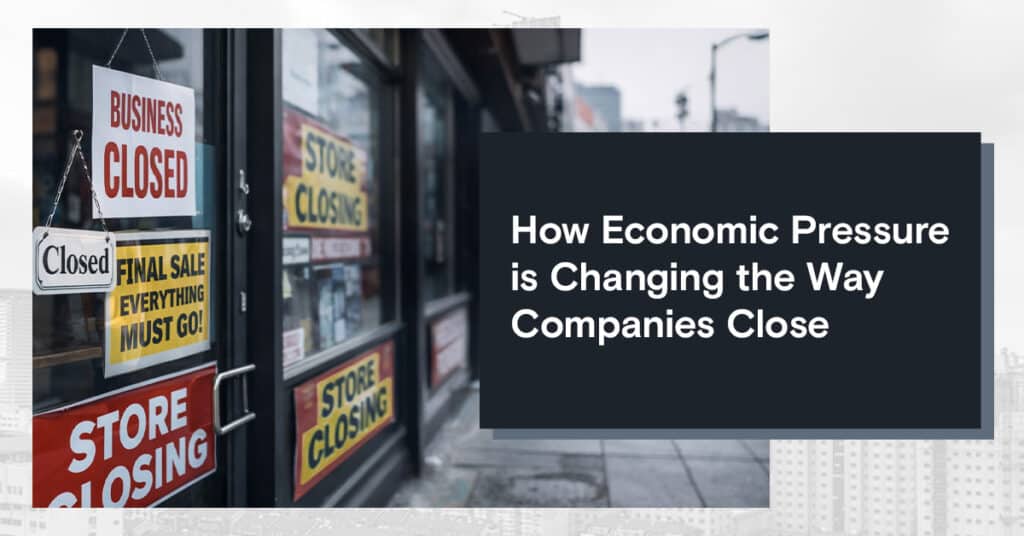
How Economic Pressure Is Changing the Way Companies Close

In recent years, the UK business landscape has been shaped by a combination of rising costs, economic uncertainty, and increased creditor pressure. From energy price fluctuations to higher wage bills and tighter tax enforcement, many companies are finding it harder to remain financially stable. As a result, the way companies approach closure is changing. Rather […]

How Economic Pressure Is Changing the Way Companies Close Read More »

Early Warning Signs of Insolvency

How to Spot Early Warning Signs of Insolvency in Your Business

Insolvency rarely happens overnight. In most cases, it develops gradually, with warning signs appearing long before a company reaches crisis point. Unfortunately, many directors either overlook these signs or delay taking action, often hoping that the situation will improve. Recognising the early indicators of insolvency is crucial. Acting at the right time can help protect

How to Spot Early Warning Signs of Insolvency in Your Business Read More »

Corporate Insolvencies Remain High

Why Corporate Insolvencies Remain High Despite Economic Recovery Signals

Recent economic data in the UK has pointed towards gradual stabilisation. Inflation has eased from its peak, interest rates have shown signs of plateauing, and GDP growth has returned in modest quarters. On the surface, these indicators suggest improvement. However, corporate insolvency figures remain historically elevated, with thousands of companies continuing to enter liquidation each

Why Corporate Insolvencies Remain High Despite Economic Recovery Signals Read More »

Directors' Insolvency Risk

How Directors Can Navigate Insolvency Risk and Legal Duties in 2026

The economic environment in 2026 remains complex for UK businesses. While some sectors show signs of stabilisation, many companies continue to face pressure from elevated borrowing costs, increased wage bills, supply chain adjustments, and more assertive creditor enforcement. In this context, directors must be particularly vigilant. UK insolvency law places clear responsibilities on directors, especially

How Directors Can Navigate Insolvency Risk and Legal Duties in 2026 Read More »

Impact of Rates Revaluation

Impact of Rates Revaluation and Tax Changes on UK Insolvency in 2026

The UK insolvency landscape in 2026 is shaped not only by economic conditions but also by structural tax and property cost changes. Among the most significant influences are business rates revaluation and evolving tax rules, including capital gains tax adjustments and wider fiscal reforms. While insolvency is rarely caused by a single factor, changes in

Impact of Rates Revaluation and Tax Changes on UK Insolvency in 2026 Read More »

PPE Medpro Liquidation

Lessons from the PPE Medpro Liquidation and Government Claims

The liquidation of PPE Medpro has become one of the most high-profile insolvency cases linked to the Covid-19 pandemic. The company, which secured substantial government contracts to supply personal protective equipment during the public health emergency, later faced legal disputes, scrutiny over contract performance, and eventual insolvency proceedings. Beyond the political attention and media coverage,

Lessons from the PPE Medpro Liquidation and Government Claims Read More »

Creditors’ Voluntary Liquidations

Why Creditors’ Voluntary Liquidations Are Outpacing Administrations

In recent years, the balance between different corporate insolvency procedures in the United Kingdom has shifted. While administration was once widely seen as the primary route for distressed companies seeking rescue, data now shows a growing preference for Creditors’ Voluntary Liquidation (CVL). This trend continued through 2024 and 2025, with CVLs rising steadily while the

Why Creditors’ Voluntary Liquidations Are Outpacing Administrations Read More »

Corporate Insolvencies in 2025

Why Corporate Insolvencies Remained High in 2025 Despite Economic Stabilisation

At first glance, 2025 appeared to offer signs of economic stabilisation in the United Kingdom. Inflation eased compared to its post-pandemic peak, supply chain disruption reduced, and interest rates stopped rising as aggressively as in previous years. Yet despite these improvements, corporate insolvencies remained stubbornly high. Around 28,000 corporate insolvency events were recorded during the

Why Corporate Insolvencies Remained High in 2025 Despite Economic Stabilisation Read More »

Slzzp Entered Administration

Why UK Furniture Brand Slzzp Entered Administration

The entry of UK furniture brand Slzzp into administration highlights the continued financial strain facing retailers operating in a challenging and evolving market. While furniture retail has historically been sensitive to economic cycles, recent years have introduced a combination of pressures that have proven particularly difficult for newer and growth-focused brands to manage. Slzzp’s administration

Why UK Furniture Brand Slzzp Entered Administration Read More »

liquidation of CCA Glasgow

Why the Centre for Contemporary Arts in Glasgow Entered Liquidation

The Centre for Contemporary Arts (CCA) in Glasgow has long been regarded as one of Scotland’s most important cultural venues, providing a platform for visual art, film, performance, music, and community-led projects. Its entry into liquidation marked a significant moment for the UK arts sector, raising difficult questions about funding models, cost pressures, and the

Why the Centre for Contemporary Arts in Glasgow Entered Liquidation Read More »