
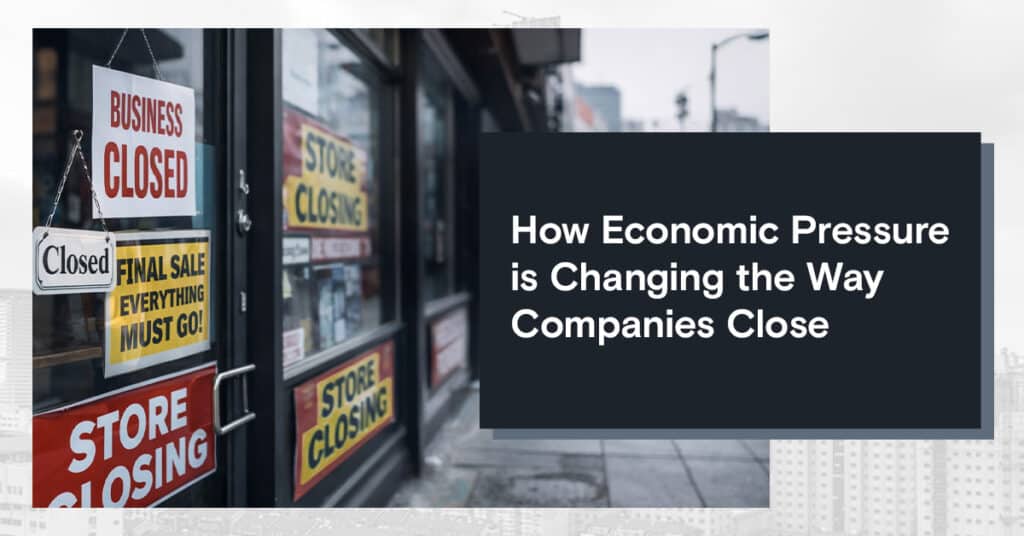
In recent years, the UK business landscape has been shaped by a combination of rising costs, economic uncertainty, and increased creditor pressure. From energy price fluctuations to higher wage bills and tighter tax enforcement, many companies are finding it harder to remain financially stable. As a result, the way companies approach closure is changing.
Rather than waiting until the situation becomes critical, more directors are taking earlier, more structured company closure action. This shift reflects a broader trend: economic pressure is not only increasing the number of closures, but also changing how and when businesses choose to close.
The Growing Weight of Economic Pressure
Businesses across the UK are facing a range of financial challenges, including:
- Increased energy and operating costs
- Higher National Insurance contributions and wages
- Rising interest rates affecting borrowing
- Ongoing supply chain disruptions
- Reduced consumer spending in key sectors
At the same time, HMRC has become more active in recovering unpaid taxes, issuing statutory demands and winding-up petitions more quickly than in previous years.
These pressures are creating a difficult environment where even previously stable businesses can experience sudden cash flow issues.
From Delayed Decisions to Early Action
Historically, many directors delayed closing their companies, often hoping that trading conditions would improve. In some cases, this led to prolonged financial distress and eventual forced liquidation.
Today, that mindset is changing.
More directors are:
- Monitoring financial performance more closely
- Recognising early signs of insolvency
- Seeking professional advice sooner
This shift towards early action allows directors to consider their options before the situation escalates. As a result, there has been a noticeable increase in controlled closures, such as Creditors’ Voluntary Liquidations (CVLs).
The Rise of Controlled, Voluntary Closure
Economic pressure has made unpredictability a major risk. Directors are increasingly looking for ways to manage that risk, and voluntary liquidation offers a structured solution.
In a CVL:
- Directors initiate the process
- A licensed insolvency practitioner is appointed
- The company is closed in an orderly and compliant way
This approach contrasts with compulsory liquidation, where creditors force closure through the courts.
The preference for voluntary closure reflects a desire to:
- Maintain control over the process
- Reduce disruption
- Ensure legal compliance
Simple Liquidation is seeing more directors explore these options earlier, rather than waiting for creditor action.
HMRC’s Role in Shaping Behaviour
HMRC is one of the most influential factors in how companies close today.
In the past, tax arrears could sometimes be managed over longer periods. However, HMRC is now:
- Acting more quickly on unpaid liabilities
- Issuing winding-up petitions sooner
- Taking a stricter approach to enforcement
This has had a direct impact on director behaviour.
Rather than risking sudden enforcement, many directors are choosing to:
- Engage with insolvency professionals early
- Avoid court proceedings
- Enter voluntary liquidation before HMRC takes action
This proactive approach reduces uncertainty and allows for better planning.
Sector-Specific Pressures Driving Change
Economic pressure is not evenly distributed. Some sectors are particularly affected, which is influencing how closures happen.
Construction
Late payments, rising material costs, and tight margins are creating cash flow challenges. Many construction firms are choosing early closure to avoid escalating debt.
Hospitality
Restaurants, pubs, and cafes are facing increased costs and reduced customer spending. Voluntary liquidation is often used to exit the market in a controlled way.
Retail
High street businesses continue to struggle with reduced footfall and online competition. Directors are increasingly opting for structured closure rather than prolonged decline.
These sector-specific pressures are accelerating the move towards earlier, more strategic decision-making.
Greater Awareness of Director Responsibilities
Another important factor is increased awareness of legal duties.
Directors now have greater access to information about:
- Wrongful trading
- Personal liability risks
- Director disqualification
Economic pressure has made these risks more immediate. As financial problems develop, directors are more aware that continuing to trade while insolvent can have serious consequences.
This has encouraged a more responsible approach, where directors:
- Prioritise creditor interests
- Seek advice at the right time
- Take action before risks increase
The Impact on Creditors and Stakeholders
The way a company closes has a direct impact on creditors, employees, and other stakeholders.
Under economic pressure, controlled closures can:
- Improve communication with creditors
- Allow for better asset realisation
- Reduce overall costs of the process
In contrast, forced liquidation can lead to:
- Sudden disruption
- Higher legal costs
- Lower returns for creditors
As directors become more aware of these outcomes, they are more likely to choose a route that benefits all parties involved.
Emotional and Practical Considerations
Economic pressure does not only affect finances. It also affects decision-making and stress levels.
Directors facing prolonged uncertainty may experience:
- Anxiety about creditor action
- Difficulty planning for the future
- Pressure from employees and suppliers
A structured closure process can provide clarity and a defined path forward. This is another reason why voluntary liquidation is becoming more common.
At Simple Liquidation, directors often seek guidance not just on the process itself, but on how to navigate the situation with confidence and clarity.
Planning for What Comes Next
One of the most significant changes is how directors view closure.
In the past, closing a company was often seen as the end of the road. Today, it is increasingly viewed as:
- A responsible decision
- A way to limit further losses
- A step towards a fresh start
Economic pressure has reinforced the importance of making timely decisions. Directors who act early are often better positioned to:
- Move on to new ventures
- Protect their professional reputation
- Learn from the experience
Conclusion
Economic pressure is reshaping not just how many companies close, but how they close.
The key changes include:
- A shift towards earlier decision-making
- Increased use of voluntary liquidation
- Greater awareness of legal responsibilities
- More proactive engagement with insolvency professionals
In a challenging economic environment, waiting is often no longer a viable option. Directors are recognising that taking control of the situation leads to better outcomes for themselves, their creditors, and their future.
Understanding these changes is essential for any director navigating financial difficulty. By staying informed and acting at the right time, it is possible to manage closure in a way that is structured, compliant, and forward-looking.